Skip to content

Digital commerce processes start with well thought-out architecture

E-commerce solutions & digital platforms

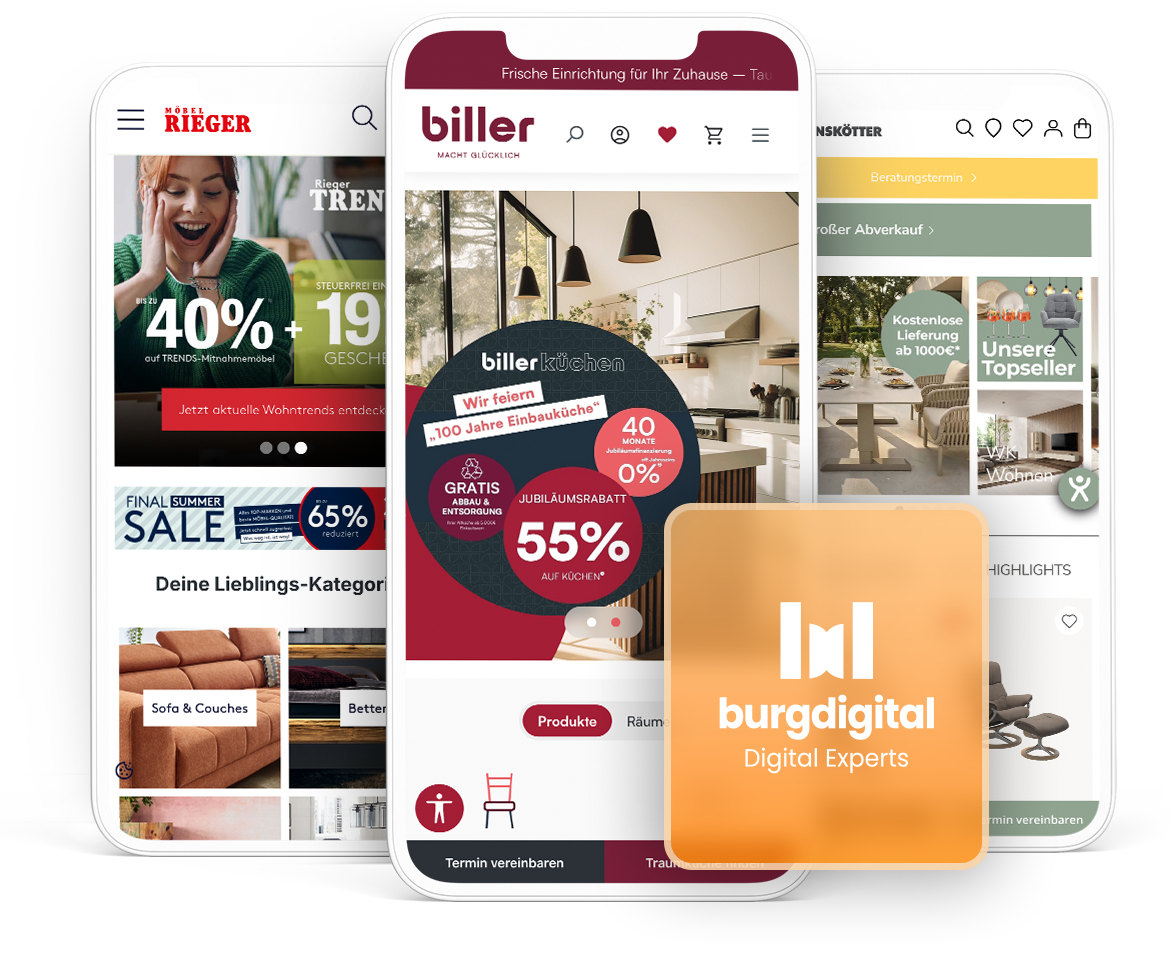
We develop e-commerce systems that become a key component of your digital value creation. With scalable platforms, clear data structures and tailor-made applications, we create commerce environments that standardize processes and support complex sales models.

AQ0A7975

Digital expertise for your e-commerce

Individual solutions for your success in digital commerce.

High-performance commerce platforms are based on clearly defined structures, consistent product and customer data and coordinated processes. Modular architectures, networked systems and centrally controlled touchpoints create an environment that enables stable processes and reliably maps complex retail models.


icon-b2b-commerce-burgdigital-1

B2B commerce

Digital processes & data models

E-business solutions for the structured mapping of customer group-specific pricing logic, product data and ordering processes within integrated system landscapes - for a clear technical basis for complex B2B sales structures.

icon-b2b2c-commerce-burgdigital-1

B2B2C Commerce & Marketplaces

Platforms for manufacturers & retailers

Systems that connect manufacturers with retailers and end customers via central data models, product range structures and multi-level marketplace logics - with scalable framework conditions for networked value chains.

icon-b2c-commerce-burgdigital

B2C online shops

Store architectures & product structures

Commerce environments that provide products, content and user interactions in clearly defined, modularly expandable store systems - as a technically consistent basis for modern sales processes.

icon-b2b2c-multichannel-burgdigital

Multichannel commerce

Channels, product ranges & interfaces

Platforms for centralized management of product ranges, inventories and touchpoints across stores, marketplaces, POS and CRM, based on integrated interfaces - a uniform foundation for coordinated system landscapes.

"90% of consumers expect their interactions and experiences to be consistent across all channels."

Source: Forbes

Successful in digital competition

E-commerce as the key to more growth and turnover.

E-commerce systems are becoming central components of digital business models. In order to survive in dynamic markets, companies need platforms that clearly map processes, provide structured data and enable cross-channel interactions.

Modern, scalable commerce architectures support consistent customer experiences and create the basis for reliable, future-proof retail processes.

Platforms that enable innovation

Our technology stack - tools that drive innovation.

Digital expertise - trends & success
Stories

Digital strategies for furniture retailers - with digital marketing, e-business and POS

Multichannel & omnichannel commerce in the furniture trade

Furniture stores today face the challenge of effectively combining digital processes and personal advice. Our industry solution combines XcalibuR, your store system and HubSpot to create an end-to-end solution - for configuration, sales and customer contact across all channels.

csm_burgdigital_multichannel_omnichannel_commerce_3383481366

Knowledge for well-founded decisions

FAQ - Answers to key questions about modern commerce systems.

What is the difference between B2C, B2B and B2B2C commerce systems?

B2C platforms focus on product presentation and the shopping experience, while B2B systems map customer-specific prices, roles and complex ordering processes. B2B2C models connect manufacturers, retailers and end customers via multi-level sales and marketplace structures.

What role does product data play in digital retail?

Centrally maintained product data, variants and attributes enable consistent information across stores, marketplaces and internal systems. PIM systems and middleware solutions support structured data models and automated display.

When is the use of a commerce platform or marketplace recommended?

Commerce platforms are suitable for defined product ranges and direct sales processes. Marketplaces are used when several suppliers, price logics or product range structures need to be managed in a central system.

How are ERP, CRM or POS integrated into commerce systems?

Stocks, customer information, prices and orders can be synchronized via APIs, middleware and event-based integration concepts. This creates a uniform database across all connected systems.

What are the technological features of modern commerce architectures?

Scalable architectures are based on clear interfaces, modular components and structured data models. This allows new channels, processes and applications to be integrated in a technically clean way and developed further in the long term.

Together we realize your visions!

Employee photo
Eugen Schitik
COO
Head of Projectmanagement

eugen.schitik@burgdigital.de
Employee photo
Pauline Eilert
Project Manager

pauline.eilert@burgdigital.de