Content Marketing Agency in Bielefeld
Content Marketing for Visibility & Performance
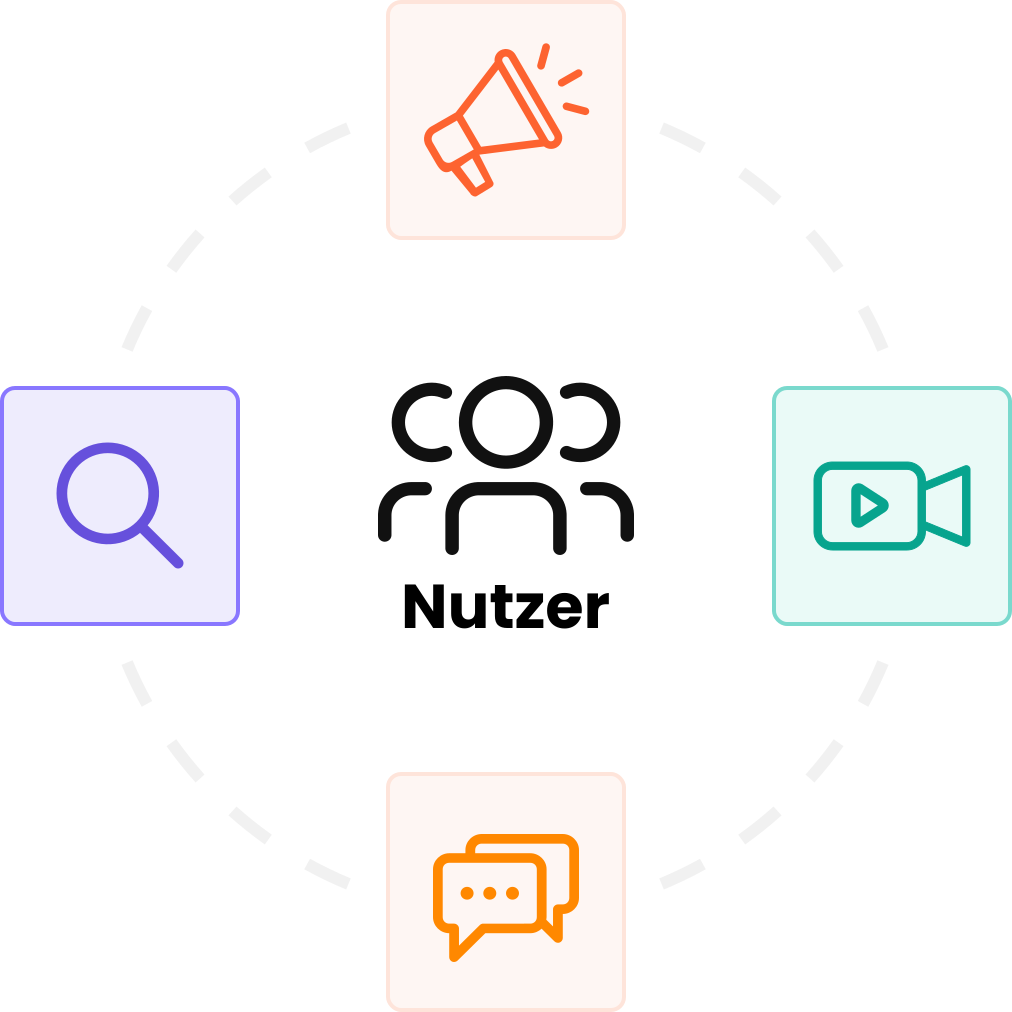
Today, users gather information simultaneously through search engines, campaigns, social media, websites, and digital platforms. Content therefore rarely works in isolation but rather along the entire customer journey and across a wide variety of usage scenarios.
Good content provides guidance, strengthens brands, and supports digital decision-making.

These days, content rarely works on just one channel
Content that brings together brand, platform, and performance
Content isn’t created on the side. It combines brand image, target audience insight, system logic, and conversion goals into clear digital communication. This is exactly where we come in: burgdigital develops content strategies and content that not only look good but also work effectively across websites, online stores, campaigns, and CRM processes.
Whether it’s an SEO landing page, a newsletter series, a social media format, or ad creative: We approach content with a cross-channel mindset, in line with the brand, and with a focus on reach, user experience, and conversion.

Services Offered by Our Content Marketing Agency
Strategically Building Content Rather Than Producing It on an Ad-Hoc Basis
From topic clusters and SEO landing pages to newsletter series, campaign formats, and content management systems: We create content with a clear structure, consistent branding, and a focus on performance, user experience, and conversion.
Strategic Content Concepts
Content strategies, topic architectures, and communication structures for digital platforms and cross-channel communication.
SEO Content & Digital Thematic Worlds
Landing pages, blog articles, and scalable thematic ecosystems for long-term visibility in search engines.
Social Media & Campaign Content
Content formats for campaigns, ads, and social media—tailored to the platform and usage context.
Conversion-Focused Content
UX copy, landing pages, and digital content for improved user guidance and performance.
Image, Motion, and Video Content
Digital assets, motion design, and AI-powered video formats for modern brand experiences.
Content for Online Stores, CMS, and B2B
Product descriptions, technical content, and scalable content for websites, e-commerce platforms, and corporate platforms.
From Analysis to Cross-Channel Delivery
Plan content in a structured way and develop it effectively
Content becomes particularly relevant when it remains visible over the long term, reaches users in a targeted manner, and ensures that digital communication functions consistently.
That’s why we don’t develop content in isolation, but rather as part of digital brand, communication, and sales structures. This results in formats, topic clusters, and content that are strategically structured and function effectively across different platforms and usage scenarios.
Analysis & Goal Setting
Digital content must meet a variety of requirements—from visibility and reach to user guidance and conversion.

That’s why we always define content, platforms, and communication goals based on specific usage scenarios and customer journeys.
Topic & Channel Strategy
Today, content rarely functions in isolation. Search engines, campaigns, social media, websites, and CRM processes are increasingly intertwined.
As a result, cross-channel thematic and communication structures are emerging in place of individual measures.
Production & Design
Depending on the platform and target audience, different formats are created—ranging from SEO content and landing pages to campaign formats, motion design, and social media assets.
The content remains consistent, scalable, and adaptable for further digital development.
Distribution & Optimization
Digital content is constantly evolving. Data, platforms, search behavior, and performance are therefore continuously factored into the optimization, prioritization, and further development of existing content structures.
Who Benefits from Content Marketing
How Businesses Benefit
Content marketing is particularly relevant when content remains visible over the long term, brands communicate consistently, and digital processes are effectively supported.
Develop content strategically rather than on a case-by-case basis
Effectively Combining SEO, User Experience, and Conversion
Communicate brands consistently across all channels
Professionally Structuring Websites, Online Stores, and Campaigns
Efficient Content Integration into Marketing and Sales Processes
Developing content structures and formats that can be used over the long term
Modern content processes require scalable systems
Content needs the right technical foundation
We don’t view content in isolation from systems. In practice, content must be maintainable, deployable, scalable, and analyzable. That’s why we work at the intersection of content, structure, and technology.
Depending on the project, we incorporate e-commerce platforms, CMS systems, GPTs, Google tools, and Sistrix. This results in content processes that are not only strategically sound but also operationally effective.
Integrating Strategy, Systems, and Content
Why burgdigital Is More Than Just a Content Marketing Agency
Content marketing doesn’t end with individual pieces of text or campaigns. For content to be effective in the long term, strategy, brand communication, technical systems, and digital processes must work together seamlessly.
This is exactly where burgdigital comes in. We integrate content with UX, SEO, web development, and digital platforms—so that content isn’t just produced, but is structured, efficiently maintained, and continuously developed over the long term.

Content Aligned with Real-World Digital Needs
How does content marketing help reach specific audiences?
Content marketing helps companies provide content tailored to specific search queries, information needs, and digital usage scenarios.
Instead of isolated, one-off measures, this results in structured content that guides users across search engines, websites, campaigns, social media, and CRM processes, leading them in a targeted manner to the next action.
What types of content and formats are part of a successful content strategy?
Which formats are most effective depends on the target audience, platform, and communication goal. These may include SEO landing pages, blog posts, campaign content, newsletters, social media posts, white papers, or digital sales materials.
What matters is not the quantity of individual pieces of content, but rather a structured strategy in which topics, formats, and channels work together effectively.
How is AI changing the requirements of modern content marketing?
AI makes it easier to create and scale content, but at the same time increases the amount of interchangeable content in the digital space.
To remain visible and relevant, content therefore needs clear structures, strategic topic planning, brand relevance, and genuine added value. What matters most is not just the production of individual pieces of content, but the quality of the overall content strategy.
Why is individual content often no longer enough these days?
Today, digital communication rarely takes place on just a single channel. Users naturally switch between search engines, websites, campaigns, social media, and digital platforms.
As a result, individual initiatives often generate only short-term attention. Long-term visibility is achieved when content is strategically planned and coordinated across all channels.
What makes a good content marketing agency?
A good content marketing agency doesn't just develop individual pieces of content or campaigns; it creates structured digital communication systems for different platforms and target audiences.
Modern content strategies combine visibility, user guidance, and digital brand communication throughout the entire customer journey—tailored to the platform, target audience, and digital usage scenarios.
For which companies is strategic content marketing worthwhile?
Strategic content marketing is particularly well-suited for companies that want to build long-term digital visibility and manage various platforms professionally.
These include corporate companies and B2B brands, as well as e-commerce platforms and growth-oriented digital brands with a regular need for content, campaigns, and cross-channel communication.