With Shopware 6.8, the existing B2B Suite will be discontinued and completely replaced by the new...
Shopware 6 Blog: Blog feature for Shopware online shops
Many online shops rely on content marketing to build additional reach via search engines. However, Shopware 6 does not offer an integrated blog function by default. With the blog solution for Shopware 6 developed by burgdigital, a blog can be integrated directly into the online shop and managed centrally in the backend.

Contents
Why a blog in your online shop makes sense
A Shopware blog adds a structured content area to your online shop for guides, inspiration, and background information. This creates additional organic entry points via search engines and opens up new opportunities for sustainable content marketing.
Reaching customers early in the customer journey
Especially in e-commerce, it is no longer sufficient to present products only. Users often look for inspiration, how‑to guides, or background information before making a purchase decision.
Challenge: No native blog function in Shopware 6
A Shopware 6 blog makes it possible to provide this content directly in your online shop and link it to products. However, Shopware 6 does not include a native blog function by default. Retailers therefore have to rely on extensions or custom solutions to integrate a blog into their shop.
"A blog enables online shops to highlight topics that go beyond classic product pages. "
Integrating a Shopware 6 blog – the blog solution from burgdigital
To close this gap, burgdigital has developed its own blog feature for Shopware 6. With this extension, a fully fledged Shopware blog can be integrated directly into the online shop without the need for an external content management system.
Blog posts are created, structured, and published centrally in the Shopware backend. At the same time, layouts can be designed flexibly and SEO information maintained. The result is a fully integrated Shopware 6 blog that connects editorial content, inspiration, and products.
Strategic advantages of a Shopware blog
- additional entry points via search engines
- structured content areas within the shop
- better linking of content and products
- long-term support for SEO and content marketing
Feature set of the Shopware 6 blog extension
The blog extension adds a structured content area for editorial articles to Shopware. Blog posts can be created, managed, and published directly in the Shopware backend.
At the same time, the solution offers various features for structuring, designing, and SEO-optimizing blog articles, so that content can be integrated precisely into the online shop’s content and marketing strategy.
Blog archive and filters by year and month
Blog posts can be archived and filtered by year or month. This keeps even extensive blogs clear and helps users find older content more quickly.
Maintaining SEO information for blog posts
For each post, key SEO data can be stored to optimize blog articles specifically for search engines.
- SEO URL
- Meta title
- Meta description
Flexible layouts for blog articles
In addition to a standardized layout, individual layouts can be used for blog articles. This makes it possible to display different content formats.
Flexible design of the blog detail page
The detail page of a blog article can be designed flexibly and adapted to different types of content.
Easy management of blog posts and categories
Blog posts and categories can be created and managed directly in the Shopware backend. This keeps maintaining the Shopware blog clear and efficient.
Scheduled publication of blog articles
Posts can be published automatically at a defined time. This simplifies the planning of editorial schedules and marketing campaigns.
Blog feature in action
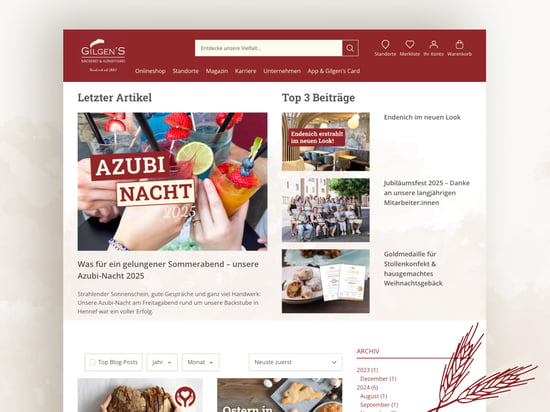
The example of the Gilgens bakery shows how a Shopware blog can be used in an online shop. There, the blog feature extends the shop with an editorial content area.
Typical use cases for a Shopware blog
Depending on the industry, a Shopware blog can fulfil different roles within the online shop. Blog articles help explain products, provide inspiration, or offer additional information about the brand.
Guide and Buying Advice
Blog articles explain products, compare variants, or provide decision support for customers.

Inspiration and trends
Especially in B2C commerce, blogs can provide inspiration – for example on interior design, fashion, or lifestyle.

Product knowledge and tutorials
Complex products can be explained in more detail in blog articles than on standard product pages.

Corporate and industry news
Blogs can also be used to communicate news from the company or the wider industry.

Conclusion
A blog extends online shops with structured areas for editorial content and creates additional entry points via search engines.
With features such as categories, archive structure, flexible layouts, and SEO management, blog posts can be managed efficiently and integrated precisely into the marketing strategy. In this way, a Shopware blog connects content marketing, SEO, and brand communication directly within the online shop.
How to create and manage a blog in Shopware 6?
Since Shopware 6 does not include a native blog function by default, blogs are usually integrated via an extension or a custom solution.
With the blog feature from burgdigital, blog posts can be created, managed, and published directly in the Shopware backend. Posts can be assigned to categories, scheduled for publication, and organized via an archive structure. This enables efficient maintenance of a Shopware blog and seamless integration into the online shop.
What are the options for setting up a Shopware 6 Blog?
When setting up a Shopware 6 blog, we support you with integrating the blog feature and structuring the content. We also provide training on how to maintain and design blog posts in the Shopware backend, enabling you to manage and expand your content independently later on.
How should a Shopware Blog be structured in a meaningful way?
A well-structured Shopware blog uses thematic categories, a clear archive structure, and suitable layouts for different article types. This keeps content easy to navigate and helps users quickly find relevant information. At the same time, a clear structure strengthens internal linking and supports search engine optimization.
What can be used to optimize blog posts for SEO?
For strong visibility in search engines, blog posts should use SEO-optimized URLs, meta titles, and meta descriptions. Structured content, relevant keywords, and internal links to products or categories further support this. In this way, a Shopware blog creates additional organic entry points into the online shop.
What are the benefits of a Shopware Blog for online shops?
A Shopware blog extends the online shop with a dedicated content area for guides, inspiration, and background information. This creates additional entry points via search engines and opens up new opportunities for content marketing. At the same time, it allows products to be explained in more detail and helps you reach customers early in their customer journey.
How can a blog be integrated into Shopware?
A blog can be integrated directly into the Shopware online shop via a blog extension. Content is created in the backend and published in a structured way, while SEO information can be maintained in parallel. This creates a central content area that connects content marketing, SEO, and product communication in one place.