


Generic AI tools quickly reach their limits when it comes to creating realistic or brand-compliant...
Artificial intelligence is changing the way content is created, organized, and delivered. In SEO, it opens up new opportunities to respond more quickly to market changes, present content in a more user-centric way, and expand visibility with greater precision.
This article shows how AI supports day-to-day SEO work, which tools already provide a real competitive advantage, and why companies should prepare early for new search technologies such as AI Overviews.
Inhalt
Less manual work, more impact
How AI Is Modernizing Day-to-Day SEO Work
Whether it is content creation, keyword clustering, or technical crawling, AI-powered tools are taking over more and more routine tasks with precision, scalability, and real-time efficiency. This not only relieves pressure on teams but also makes SEO processes more agile overall. The key is not to use AI in isolation, but to integrate it meaningfully into the existing strategy and tool landscape.
Generative Engine Optimization (GEO)
What Is GEO – and Why Is It the Next Step in AI SEO?
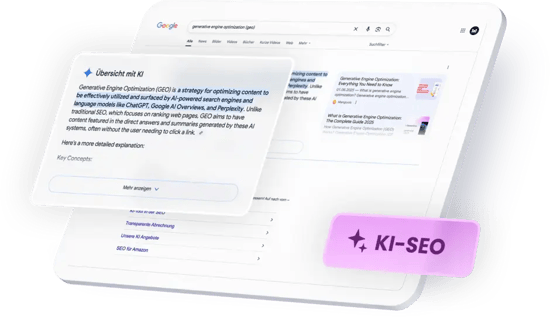
As generative AI becomes increasingly integrated into search results, it is not only the presentation that is changing, but also the requirements for content. Traditional rankings are now being complemented by AI-based answer formats, such as Google AI Overviews. This is exactly where Generative Engine Optimization (GEO) comes in.
GEO aims to prepare content in a way that allows it to be considered in these new search formats in the first place: clear, contextually relevant, and structurally suited for machine-generated summaries.
What Matters Most in GEO
1. Structure Before Style
Clear sections, subheadings, and concise wording
2. Think in Answers
Frame content so it directly answers specific questions.
3. Semantically Enriched
Content must be topically in-depth, contextually relevant, and editorially precise.
1. Better Understand Semantics
AI automatically groups related terms and helps create content that is thematically consistent.
2. Analyze Search Intent
Tools identify whether queries are informational, transactional, or navigational.
3. Optimize the User Journey
AI supports the targeted delivery of content along the customer journey.
4. Measure and Optimize Performance
Tools such as SISTRIX show how visible content really is in AI-driven search results.
5. Automate Outreach and Off-Page SEO
Identify relevant domains and launch scalable link-building processes.
From Analysis to Automation
These AI Tools Create a Real Competitive Advantage
The modern SEO toolset is evolving rapidly—and AI is more than just an add-on. Whether it’s content creation, keyword mapping, or technical analysis, many tools have long offered intelligent features that streamline processes and help make more informed decisions. Instead of focusing on quantity, it’s better to select 3–5 tools that align with your goals, resources, and existing infrastructure.
For keyword and SERP analysis
- ChatGPT, Jasper, Neuroflash → help with content creation and brainstorming
- SurferSEO, Clearscope → combine an editor with data-driven SEO logic
For Content & Text Optimization
- SISTRIX AI Snapshots → Show visibility in generative search formats
- SEMrush, Ahrefs → provide semantic keyword groups and competitive analysis
For Technology & Automation
- Ryte, Seobility → analyze page structure, indexing, and technical errors
- Screaming Frog (AI module) → identifies patterns and SEO opportunities during the crawling process
AI-generated search results are changing click behavior and reach
Google AI Overviews: The Future of Visibility?
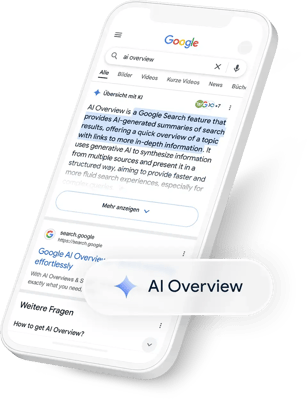
With Search Generative Experience (SGE), Google is testing a new search experience: information is summarized directly in generative answer boxes—above the traditional list of results. For many search queries, this means fewer clicks on external websites, even though the content remains relevant. This leads to reduced visibility, particularly for information-driven topics.
Challenge
-
Loss of visibility for traditional organic search results
- Increased competition for rankings in the generative answers
Opportunities
-
New sources of traffic through geo-optimized content
-
Tangible value through tailored content strategies
Understanding and Strategically Optimizing AI Visibility
Measuring visibility effectively:
With SISTRIX AI Snapshots
AI Overviews are changing not only search behavior but also the way visibility is achieved—especially for information-driven topics. Content that doesn’t appear in the generative answer boxes loses reach.
This is exactly where SISTRIX AI Snapshots comes in: For the first time, this analysis tool makes it possible to systematically track your own presence in AI Overviews—from visible domains and included content to the impact on click-through rates. For businesses, this provides a new basis for action to identify GEO potential and optimize visibility in a targeted manner.
Maximise visibility with an SEO check
Avoid losing visibility & optimise your rankings!
Would you like to know how you can improve your website’s visibility in the long term? Let us identify your site’s potential and boost your rankings over the long term.
Why AI is changing the nature of work, but not strategic responsibility
Will AI replace SEO?
This question is often asked – and the answer is clear: no. Artificial intelligence changes processes, not principles. It analyses, accelerates and provides new impetus. But it replaces neither strategic thinking nor editorial quality.
Understanding the target audience, tone and brand message cannot be automated. Content must still be reviewed, adapted and placed in context. And when it comes to E-E-A-T – that is, Experience, Expertise, Authoritativeness and Trustworthiness – genuine authority remains a human factor.
What is AI SEO?
AI SEO refers to the use of artificial intelligence in search engine optimisation. AI tools handle tasks such as text generation, keyword analysis and technical optimisation – more quickly and in a more data-driven way than purely manual processes.
Which tools are suitable for SEO?
Different tools are used depending on the area of application:
- Content creation: ChatGPT, Jasper, SurferSEO
- Keyword analysis: SISTRIX, Ahrefs, SEMrush
- Technical optimisation: Ryte, Seobility, Screaming Frog, MarketMuse
How do Google AI Overviews affect visibility?
For many search queries, Google displays AI-generated summaries directly within the results. This reduces the number of clicks on traditional search results. Those who don’t appear there lose reach – particularly when it comes to informative content.
How does AI SEO differ from traditional SEO?
Traditional SEO relies heavily on manual analysis and content creation. AI-powered SEO uses automation tools to create content more quickly, identify patterns and make data-driven decisions – but remains strategically guided.
What are the risks of using AI for SEO?
The risks include:
- content that sounds unnatural and lacks tonefactual errors or outdated information
- duplicate content
That is why quality control and strategic integration are essential.
How quickly can you see results with AI SEO?
Visible results usually become apparent after several weeks. AI can speed up the process, but it does not replace the organic maturation process of a sustainable SEO strategy.
Does burgdigital offer AI-powered SEO consultancy?
Yes. We make targeted use of modern AI tools – from analysis through to implementation. In doing so, we focus on quality, strategy and long-term impact – always tailored specifically to your business.
