Skip to content

AI Agents: The Future After Chatbots

AI Agents: The Future After Chatbots
2:00
Picture of Eugen Schitik

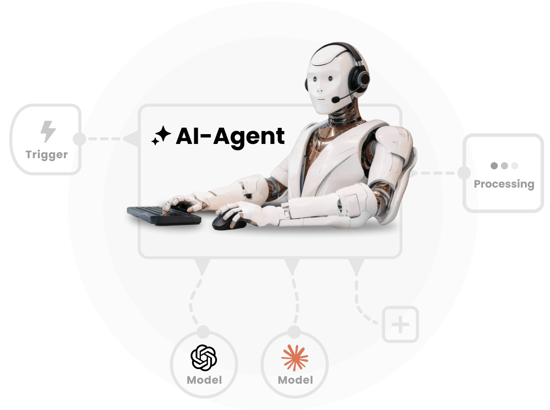
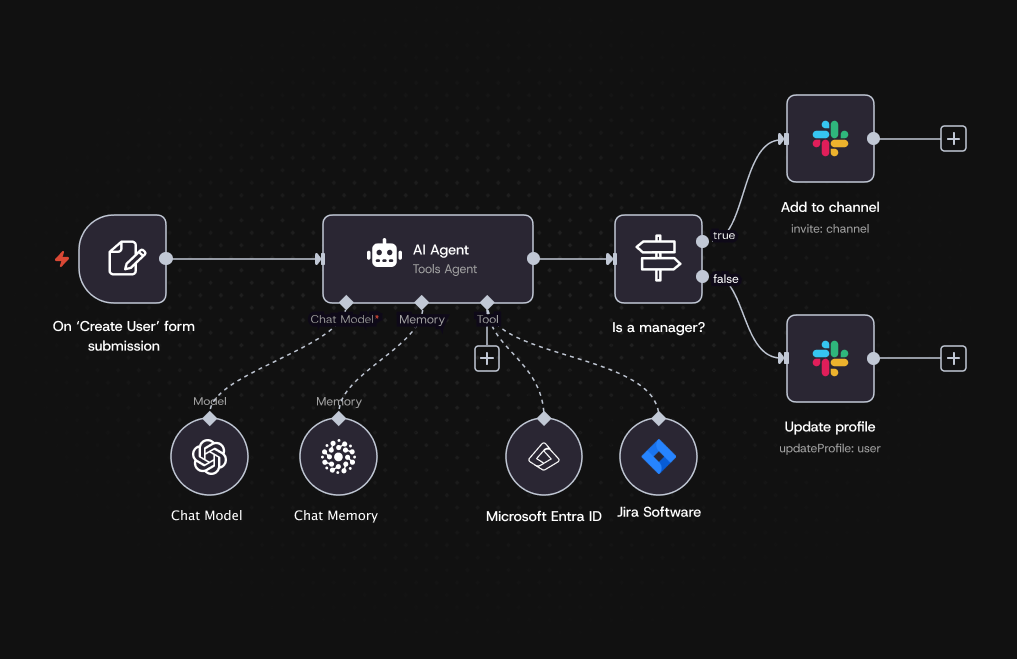
Visualisierung eines KI-Workflows mit Integration eines KI-Agenten

Generative AI has already found its way into many companies. Tools like ChatGPT or Copilot support research, content creation, and knowledge management. Chatbots are also being used more frequently, for example in customer service or for internal support processes.

However, in practice the limitations of these applications quickly become apparent: they provide information and answers – but rarely take over concrete tasks within the company. This is exactly where the next stage of AI use begins: AI agents.
From AI chat to AI automation

Chat-based AI systems have significantly simplified access to artificial intelligence. Users can ask questions, generate content, or compile information. For many business processes, however, this is not enough.

Companies need systems that do more than communicate – they must be able to act operationally, for example by analysing data, interacting with other systems, or executing tasks automatically.

AI agents extend exactly this principle. They connect generative AI with system access, APIs, and process logic. This enables them to take over tasks, prepare decisions, and support workflows. The focus thus shifts from interacting with AI to AI‑driven automation of processes.

"AI agents will increasingly act on behalf of users and complete tasks, rather than merely answering questions."

Sam Altman, OpenAI

What are AI agents?

AI agents are intelligent systems that can perform tasks within defined parameters. They access data sources, use tools or interfaces, and support decision-making along digital processes.

Unlike classic chatbots, the focus is no longer on individual answers, but on concrete actions within a system or workflow. As a result, AI agents are increasingly becoming an operational component of digital systems.

Typical functions of AI agents include:

  • Research and analysis of information
  • Use of APIs or internal systems
  • Automated decision support
  • Execution of multi‑step process flows
burgdigital_news_ki_agenten_n8n

Why AI agents are becoming relevant for businesses

Many companies have already introduced initial AI applications. The next step is to embed these technologies more deeply into operational workflows. This is particularly relevant in areas such as customer service, e-commerce, sales, and data analytics – and it is precisely here that AI agents unlock their potential.

They enable, among other things:

  • Increased efficiency by reducing manual tasks
  • AI-based automation of processes, for example in service, marketing, or analytics
  • Scalable use of AI, as systems can take over tasks autonomously
burgdigital_news_ki_agenten_vorteile

Examples of AI agents in practice

In practice, many new use cases for AI agents are emerging. In all of them, AI is no longer just a tool for information, but an integrated part of an automated process.

The decisive factor: integration into existing systems

For AI agents to create real value in a company, they must be integrated into the existing system landscape. Only through this integration can AI agents execute tasks reliably and effectively support processes.

This also makes it clear that AI agents are not a standalone product, but part of a broader AI architecture within the company..

This includes, among other things:

  • Data platforms and data sources
  • CRM and ERP systems
  • internal tools and APIs
  • existing process logic

Conclusion: from AI tools to AI agents and automated systems

The evolution of enterprise AI is shifting from isolated tools towards integrated, automated systems. While chatbots primarily enable interaction, AI agents can take over tasks and automate end-to-end processes. This is where their greatest value for businesses lies.

For many organisations, the key question will no longer be whether they use AI, but how deeply they embed it into their business processes.

FAQ - Frequently asked questions about AI agents

What are AI agents?

AI agents are systems that use artificial intelligence to execute tasks and support processes. They access data sources, connect to other systems via interfaces, and carry out defined work steps automatically. Unlike classic chatbots, the focus is not on individual answers but on concrete actions.

How are AI agents different from chatbots?

Chatbots are primarily designed for interaction – they answer questions and provide information. AI agents go a step further: they can execute tasks, interact with systems, and support multi-step processes. This makes them an operational part of digital workflows.

In which areas can companies use AI agents?

AI agents can be deployed across many areas of a business. Typical use cases include customer service, marketing and sales, e-commerce, and data analytics. In these contexts, they can, for example, analyse requests, evaluate data, or automate individual process steps.

What are the prerequisites for companies to use AI agents?

For AI agents to operate reliably, they must be integrated with existing systems and data sources. This typically includes CRM or ERP platforms as well as internal tools and APIs. It is also crucial to identify suitable processes that are appropriate for automation.

From chatbots to real AI processes

Discover how AI agents can automate tasks and make your processes more efficient.