


With Instant Checkout in ChatGPT, OpenAI demonstrates the direction in which online retail is...
Google Universal Commerce Protocol: This is changing
Google Universal Commerce Protocol: This is changing
3:03
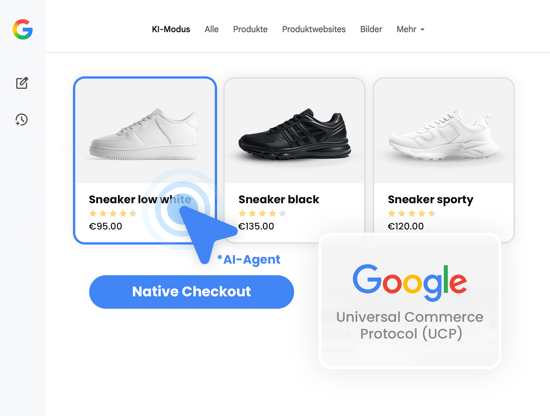
Google is fundamentally changing how products are discovered and purchased. With the Universal Commerce Protocol (UCP), the entire purchasing process is shifting into AI‑driven interfaces – from product search through to checkout.
Contents
- Key impacts at a glance
- What this means for online shops
- The Universal Commerce Protocol (UCP) explained
- How UCP enables agent‑driven commerce
- Why UCP is becoming the standard in digital commerce
- Core building blocks of Google UCP
- Agentic Commerce Protocol (ACP): Positioning within the UCP context
- Our assessment
- Example: Who wins – and who loses
- How burgdigital prepares companies for UCP and agentic commerce
- FAQ
Key impacts at a glance
- Google takes over parts of the customer journey
Users increasingly interact directly with AI systems instead of visiting websites. - SEO traffic in e‑commerce will decline over time
with significantly fewer website clicks during research and comparison phases. - Structured product data becomes critical for visibility
as AI systems primarily rely on machine‑readable data rather than traditional content. - Shops without a clear data strategy will lose reach
as products that are not provided in a structured way are simply not considered by AI systems.
What this means for online shops
The requirements for e‑commerce systems are changing fundamentally. Success now depends not only on how easily content can be found, but on whether systems are accessible and usable for AI agents.
Concretely, this means:
- Systems must be machine‑readable and agent‑ready
- Product, price, and offer data must be available in a structured format
- Payment and identity processes must operate reliably
Only then can products surface in agent‑driven commerce environments.
How companies can prepare for UCP
Many shops are currently not prepared for agent‑driven commerce processes. What matters is less a single measure and more the ability to connect product data, systems, and interfaces consistently.
Only when these fundamentals work together can AI systems reliably capture, evaluate, and integrate products into purchasing processes.
Key action areas:
- Structure product data
Complete, consistent data is essential for processing by AI systems. - Establish a feed and data strategy
Systems such as Google Merchant Center become the central hub for product information. - Provide technical interfaces
APIs and automated data flows ensure that products are reliably accessible.
The Universal Commerce Protocol (UCP) explained in simple terms
The Universal Commerce Protocol (UCP) is a Google‑initiated standard that enables AI systems to access shops, product data, and checkout processes directly.
The aim is to create a unified interface through which AI agents can discover products, compare them, and execute transactions – regardless of platform or channel.
This fundamentally changes the role of websites:
They are no longer necessarily the central touchpoint in the purchase journey, but part of a machine‑readable infrastructure.
How UCP enables agent‑driven commerce
UCP enables AI agents to discover products, check availability, compare prices, and complete purchases directly within AI interfaces such as Google Search (AI mode) or Gemini – without a traditional website handover. This makes it possible for purchase journeys to be mapped as fully agent‑driven processes for the first time.
What is new here:
- Product discovery takes place directly within AI systems
- Price comparison and purchase decisions are automated
- Transactions can be completed without visiting a website
Why this is critical for businesses:
Instead of users actively visiting shops, algorithms increasingly determine which products appear at all. As a result, the quality and structure of the underlying data become more important than the website itself.
Why UCP is becoming the standard in digital commerce
Google is positioning UCP as a new infrastructural base layer for digital commerce – comparable to past “must‑haves” such as mobile optimisation or structured data.
The key difference:
With the rise of AI interfaces, the technical foundation of e‑commerce is shifting. Systems no longer only need to work for human users; they must be directly accessible to and interpretable by machines.
What this means in practice:
- Systems must be built to be interoperable and standardized
- Data must be available and usable across all systems
- Commerce processes become part of a higher-level infrastructure
For retailers and platform operators, this means:
Those who adopt UCP early create the foundation for scalability and connectivity in new commerce ecosystems.
"In future, visibility in e-commerce will no longer be created in the frontend, but in the agent-ready infrastructure."
Key components of Google UCP
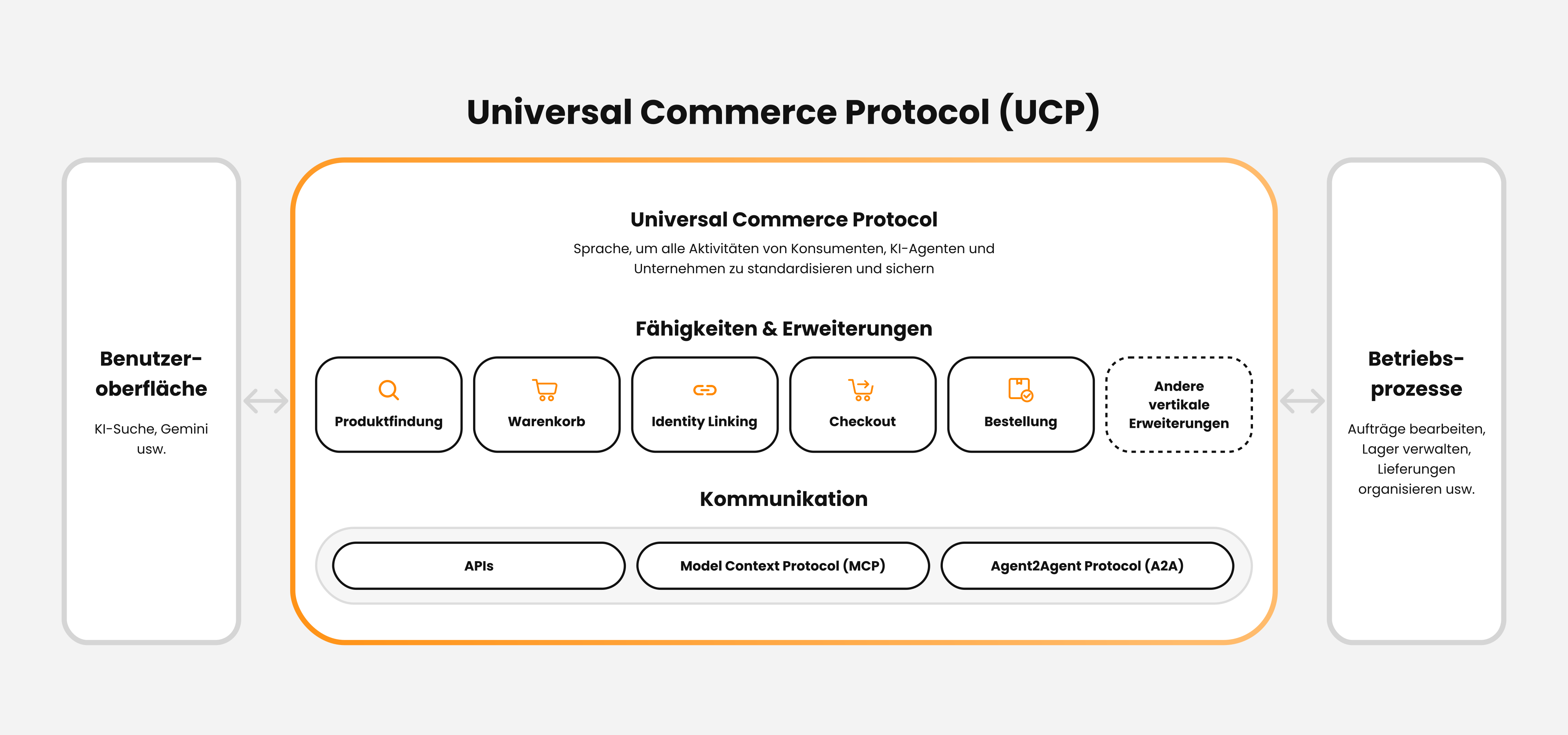
To enable AI agents to execute purchase processes autonomously, UCP defines several technical core components. They form the basis for processing products, prices, and transactions across systems.
These components are crucial because they determine whether a shop can be understood and taken into account by AI systems at all.
Agent readiness: discoverability and accessibility
Commerce systems should be clearly discoverable and prepared in a machine-readable way for AI agents. In practice, this means product data, functions, and processes are structured so they can be processed automatically.
If this foundation is missing, agents cannot reliably identify which information is available – and the shop is simply ignored.
Capability profiles: which actions are possible
Capability profiles define which actions an AI agent is allowed to perform in a shop – from product search through to completing a purchase.
For merchants, this means they retain control over which interactions are permitted, but must define them clearly so AI systems can use them.
Payment negotiations: flexible payment logic
UCP standardises how payment methods and terms are coordinated between agents, shops, and payment providers.
This enables AI systems to compare prices, weigh up options, and execute transactions directly – without users having to control the process manually.
Identity linking: trust and attribution
With identity linking, user and merchant identities can be clearly mapped across systems. This allows AI agents to act on behalf of users without bypassing existing security or compliance structures.
Agentic Commerce Protocol (ACP): positioning in the context of UCP
Alongside UCP, the Agentic Commerce Protocol (ACP) is emerging as another approach to agent-driven commerce.
While ACP focuses more on direct interaction within AI systems – such as product selection and checkout in conversations – UCP addresses the underlying technical infrastructure.
The difference is crucial:
- UCP defines the foundation on which systems communicate with each other
- ACP describes how interactions take place within AI interfaces
Both approaches are interconnected but address different layers of agent‑driven commerce. To remain visible in the long term, businesses must understand both the infrastructure (UCP) and the interaction logic (ACP).
Aspect
UCP (Infrastructure)
ACP (Interaction)
Goal
Standard for the entire agentic commerce process
Direct checkout within the AI conversation
Focus
Discovery, checkout & post-purchase
Purchase completion within AI interfaces
Interoperability
High, across systems and platforms
More platform-bound
Checkout & payment
Negotiable, standardized
Directly integrated
Role in e-commerce
Technical infrastructure
Interaction and process layer
Our assessment
The Universal Commerce Protocol is often seen as a purely technical topic – in reality, it marks a structural shift in e-commerce. The crucial change lies in who ultimately decides what becomes visible.
Where websites used to be at the centre, this role is increasingly shifting to platforms and AI systems. For companies, this means that the key question is whether their systems and data can be processed and used by these platforms.
Example: who wins – and who loses
A user searches for a product via an AI system – for example, “best wireless headphones under 200 euros”. A shop with structured product data, up-to-date prices, and clearly defined attributes can be included directly in the selection. The system can compare and prioritise offers.
A shop without consistent data or a feed connection, on the other hand, will not be considered – regardless of how visible it was before. What matters is whether products are accessible to and analysable by these systems.

How burgdigital prepares companies for UCP & agentic commerce
AI-driven commerce processes create new requirements for data, systems, and integrations. The key is to align these components so that they function reliably in agent-driven environments.
We support companies in systematically evolving their e-commerce platforms – from analysing existing structures through to implementing agent-ready systems.
Our key areas of focus:
- Analysis of existing e-commerce architectures
- Identification of gaps in data structures, interfaces, and system capabilities
- Structuring product, price, and capability data
- Building a data foundation for machine-readable use
- Preparing for UCP- and ACP-compatible interfaces
- Development and integration of agent-ready APIs and data flows
What is Agentic Commerce in E-Commerce?
Agentic commerce describes a new form of online trade in which AI agents can independently search for, compare, and purchase products. The entire purchase process shifts from websites into AI-based interfaces such as search engines or assistants.
What is Google’s Universal Commerce Protocol (UCP)?
The Universal Commerce Protocol (UCP) is a standard introduced by Google that enables AI systems to access product data, shops, and checkout processes. Its goal is to standardise commerce processes across systems in a machine-readable way.
How is UCP changing the e-commerce strategy of companies?
UCP shifts the focus from content and rankings to structured data and system capability. Companies must ensure that their products are accessible to AI agents via interfaces and data feeds if they want to remain visible.
What is the difference between UCP (Google) and ACP (OpenAI)?
UCP is an open infrastructure standard for the entire commerce process – from discovery through to checkout. ACP, on the other hand, focuses more on dialogue-based purchasing within AI systems such as chatbots.
How can companies prepare their website for UCP?
Companies should structure their product data, optimise data feeds, and provide robust interfaces. What matters is that products are machine-readable and reliably accessible for AI systems.
Is your shop ready for agentic commerce?
Many companies currently do not know how well their systems are already prepared for AI-based purchase processes – or where concrete gaps still exist.
We analyse your existing e-commerce architecture and show you how to align your data, interfaces, and processes specifically with UCP and agentic commerce.
